


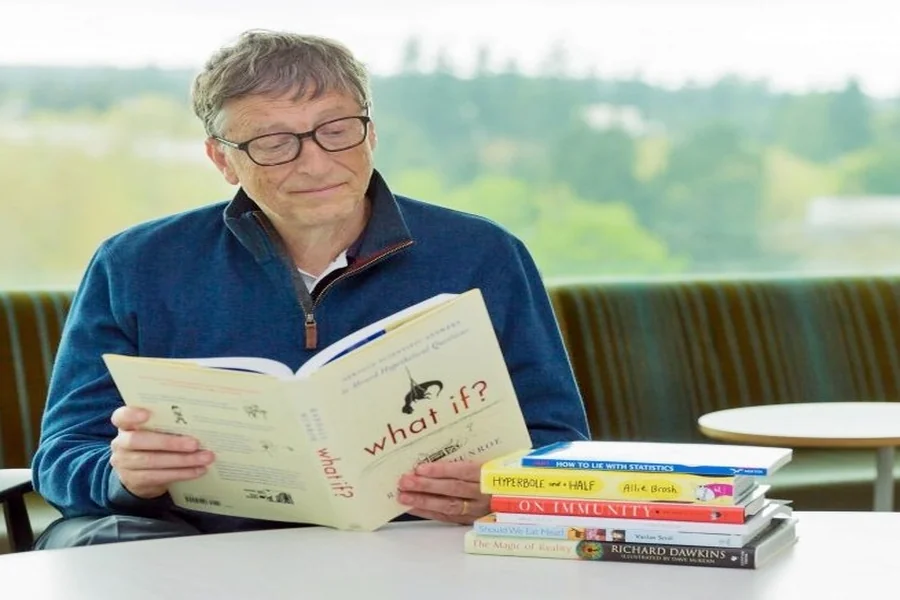
Many leadership habits get attention.
Morning routines. Cold showers. Productivity hacks. Complex planning systems.
But one habit quietly separates strong CEOs from average ones: reading every day.
Not scrolling. Not reacting to headlines. Reading with focus.
Learning is not optional at the leadership level. It is a competitive advantage.
Leaders who stop learning slowly lose edge. Markets change. Industries shift. Technology evolves. Customer behavior adapts. If a CEO’s thinking stays static, the company follows.
Reading keeps thinking sharp.
Information Is Leverage
A CEO makes decisions all day.
Hiring decisions. Strategic direction. Risk assessment. Capital allocation. Market positioning.
Better input leads to better output.
Reading expands perspective. It exposes leaders to new models, new case studies, new failures, and new patterns.
The broader the knowledge base, the faster the recognition of opportunity and risk.
Research from McKinsey and other management studies consistently shows that companies led by executives who prioritize continuous learning outperform peers in adaptability and long-term resilience.
The advantage is not intelligence. It is exposure.
Reading increases exposure.
Reading Strengthens Pattern Recognition
Experience teaches lessons. Reading accelerates them.
A CEO who reads widely absorbs lessons from industries beyond their own. That creates pattern recognition.
A logistics bottleneck in one sector might mirror a workflow issue in another. A customer loyalty strategy in retail may apply to professional services. A management failure in a public company may signal a culture risk in a small firm.
Reading connects dots faster than trial and error alone.
That speed matters.
It Improves Strategic Thinking
Leaders often confuse busyness with effectiveness.
Meetings fill calendars. Emails demand attention. Operational fires consume time.
Reading forces pause.
That pause creates space for higher-level thinking.
Instead of reacting all day, CEOs who read regularly build deeper mental frameworks. They see trends earlier. They challenge assumptions. They refine strategy.
Strategic thinking does not appear spontaneously. It develops through deliberate input.
Reading is one of the most reliable inputs.
Reading Strengthens Communication
Strong leadership depends on clear communication.
Leaders must explain direction, motivate teams, negotiate with partners, and influence stakeholders.
Reading improves language precision. It improves clarity of thought. It sharpens argument structure.
Exposure to strong writing models improves communication habits.
Clear thinking produces clear direction.
Teams follow clarity.
It Encourages Humility
The higher someone rises in leadership, the easier it becomes to assume expertise.
Reading disrupts that illusion.
Books, long-form journalism, industry analysis, and historical case studies remind leaders that no one has complete knowledge.
Humility is not weakness. It is strategic strength.
Leaders who remain curious adapt faster.
Leaders who believe they already know enough fall behind.
Daily reading reinforces curiosity.
Consistency Matters More Than Volume
The advantage does not come from reading one book a year.
It comes from reading consistently.
Twenty minutes daily compounds.
Articles. Books. Reports. Biographies. Market analysis.
The format matters less than the discipline.
This mindset reflects the approach of executives like Alejandro Gomez Cobo, who emphasize steady learning as part of structured leadership. Consistent reading strengthens judgment over time and reinforces operational clarity.
Learning compounds just like execution does.
Reading Reduces Reactive Leadership
Without structured input, CEOs become reactive.
They respond to the loudest problem. The newest trend. The most recent crisis.
Reading introduces a broader context.
Context reduces emotional decision-making.
Instead of reacting to short-term noise, informed leaders evaluate decisions against historical patterns and long-term principles.
That stability improves outcomes.
What CEOs Should Be Reading
The most effective leaders read across categories.
Industry-specific analysis keeps them current.
Economic and policy reporting improves macro awareness.
Biographies reveal leadership patterns across decades.
Operational books refine systems thinking.
Psychology strengthens understanding of human behavior.
Diverse input produces flexible thinking.
Flexible thinking produces a resilient strategy.
The Compounding Effect
The real power of daily reading is not immediate.
It is cumulative.
Ten pages a day equals thousands of pages per year.
Those pages reshape thinking slowly.
Better thinking improves decisions.
Better decisions strengthen companies.
The impact may not be visible in a single quarter, but over the years it becomes undeniable.
A Simple Standard
A practical rule for any CEO:
If you are not learning daily, your competitors eventually will.
Markets reward adaptation.
Adaptation requires awareness.
Awareness requires input.
Reading remains one of the most efficient ways to upgrade leadership capacity without increasing organizational complexity.
The Quiet Habit That Builds the Strongest Leaders
Leadership advantage does not always come from louder moves or bigger risks.
Sometimes it comes from quiet discipline.
Reading every day builds knowledge.
Knowledge sharpens judgment.
Judgment drives better decisions.
Better decisions build stronger companies.
It is a simple habit.
But over time, it becomes a serious edge.
