


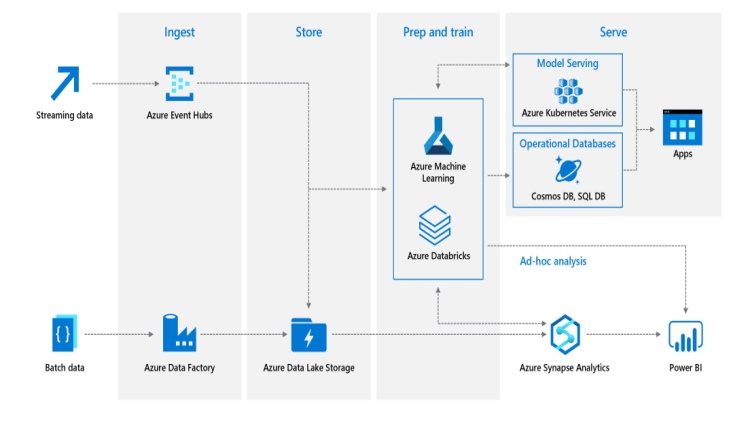
The modern data stack uses the characteristics of a conventional stack and a queue. These types of data structures are used to temporarily hold data items as they are needed. A big difference between the traditional queue and the modern stack is that in a queue, the data elements are added at the bottom and removed from the top. Hence, the oldest element in the queue is processed first.
In a data stack, the elements are placed on the top of the stack and also removed from the top. Hence, the technique called LIFO is used (last in, first out).
But these are just technologies. Technologies are important only when they are adopted and there is a culture of using these technologies. This is also true for nurturing a data culture. What exactly is a data-driven culture?
Data never lies. What gives rise to lies? When something is open to beliefs and intuitions.
When you intuit, you can intuit in multiple ways and soon, the line between a lie and a truth is blurred. Data, on the other hand, cannot be intuited. It can just be stated. 2+2 is 4 is not an opinion. It is a fact.
Hence, in a data-driven culture, you make decisions and base your business strategy on data. In such a culture, data is your strategic asset. You make your data widely available and accessible so that it can be used for decision-making, analysis and forecasting.
Every process focuses on capturing, cleaning and curating meaningful data from your entire business base. When you incorporate machine learning, when you capturing and curating data, your processes also learn through experimentation and improvisation.
Building a modern data stack to nurture a data-driven culture
Since data is crucial to your organization’s decision-making process, you need to establish ways of generating this data in as constructive manner as possible. Listed below are some approaches that you can follow to ensure data integrity and clarity.
Build a cloud-based data warehouse
This has multiple benefits. Precisely this is a reason why creating cloud-based data warehouses has caught on with such force. Cloud data warehouses are highly scalable and accessible. You can run queries through terabytes of data with simple commands embedded into your business intelligence solution or directly through SQL language.
Just as it is easier to run queries, it is also easier to store data as it is being generated by your various departments, employees, customers & clients and suppliers.
Cloud-based data warehousing solutions, being scalable, are also affordable. You can scale up your data warehousing operations as you go. Since the cloud infrastructure is being taken care of by another company, you don’t need to worry about security or safety. For extra security, you can use data warehousing services provided by reputed companies like Google, Amazon or Microsoft.
Establish an ETL process
Although, through machine learning and artificial intelligence, you can obtain invaluable insights even from unstructured data, you can save resources and time by having processes in place that extract, load and transform data so that it can be seamlessly used by your BI system.
ETL stands for extract, transform and load. You extract data, transform it so that it can be used, and then load it to the cloud data warehouse.
These processes can be machine-controlled or human-controlled. There must be an organization-wide consensus on how various employees and software applications are going to handle data.
Data can be generated through manually entering it, through extracting it from paper documents, or as a byproduct of interactions between employees and customers, customers and mobile apps, employees and mobile apps, and between various IT assets.
Data collection culture
The above-mentioned ETL explanation describes how data must be collected, but your organization must also distinguish between different types of data and data sources.
There can be event data: what users and employees do when they’re interacting with your products, services or IT assets.
Transactional data: transactions don’t just happen between your customers and your shopping cart. Even when you send a query to your database, transactions are happening. You must record even these transactions. For example, when data is inserted, or edited, or deleted, these events must also be recorded so that they can be analyzed later.
Quality data can also be collected through the various third-party services that you use, for example Google Analytics, Shopify and AdWords.
How to initiate a data-driven culture?
It begins at the top, actually. Organizations with strong data-driven cultures normally have top managers who set an example and communicate their expectation that decisions must be based on data. This should be the norm, not an exception. The top management of your organization must lead by example. Practices like data-driven business intelligence culture propagate downwards.
This is because junior employees often need to communicate to senior employees in a language and in a manner preferred by senior employees. Hence, if senior employees expect data-driven presentations, your employees will be compelled to use hard data to make their point.
You should also bring your data scientists into the mainstream organizational ecosystem. Data scientists in most of the organizations are considered “nerds” who mostly function in computer-ridden darkrooms. They are a-social and they don’t communicate with other employees.
This is a wrong strategy. If you want to make your data mainstream, you also need to make your data scientists mainstream. This normalizes data. This communicates to your employees that data is not something esoteric and it is a part and parcel of the day-to-day life in your organization.
Make it easy to obtain and save data. Train your employees if there is a need. Sensitise them. Just as there are orientation programs for employees whenever new business processes and transformational changes are introduced, train your employees on the importance of extracting and preserving data and why data-driven decision-making is at the center of your organizational proceedings.
You should also avoid creating “data tribes” within your organization. Yes, such tribes exist. Departments and individuals can be protective of the data they generate during their day-to-day activities. This can be a part of the overall culture nurturing. Communicate to the employees that the data belongs to the organization and not to single departments and individuals. It is a shared heritage.
